Future-Proofing Real Estate: How Investing in Sustainability Prepares Properties for Evolving Market Demands


Sustainable real estate is becoming essential as climate risks, rising insurance costs, and stricter regulations increasingly impact property values. By integrating resilient design, energy efficiency, and low carbon materials, developers can reduce operational costs, attract premium tenants, secure better financing, and avoid future compliance penalties. Ultimately, sustainability is no longer optional but a core driver of long term property performance and market competitiveness.


The world of real estate is facing a dual challenge: the immediate physical risks posed by a changing climate and the inevitable shift in market valuation driven by stringent environmental regulations and evolving tenant expectations.
For forward-thinking investors and developers, this challenge presents an unparalleled opportunity. Investing in sustainability is no longer a luxury: it’s a foundational strategy for future-proofing real estate assets.
This article explores how integrating sustainable practices and technologies allows properties to reduce climate risks, meet the skyrocketing demand for green buildings, and ultimately secure higher, more resilient valuations in the years ahead.

Mitigating Physical and Financial Climate Risks
The most immediate threat to long-term real estate value arises from the physical impacts of climate change, extreme weather, rising sea levels, wildfires, and deteriorating air quality. Sustainable investments function as a defensive and offensive strategy, protecting both asset performance and operational continuity.
Climate Resilience and Operational Continuity
Sustainable design upgrades directly enhance building resilience, which organizations such as UNEP and IPCC recommend as essential climate adaptation strategies.
Water Management
Smart landscaping and permeable surfaces mitigate flood risk by reducing stormwater runoff and enhancing ground absorption. Guidance from the EPA shows that water-efficient fixtures and greywater reuse dramatically reduce water consumption and vulnerability during shortages.
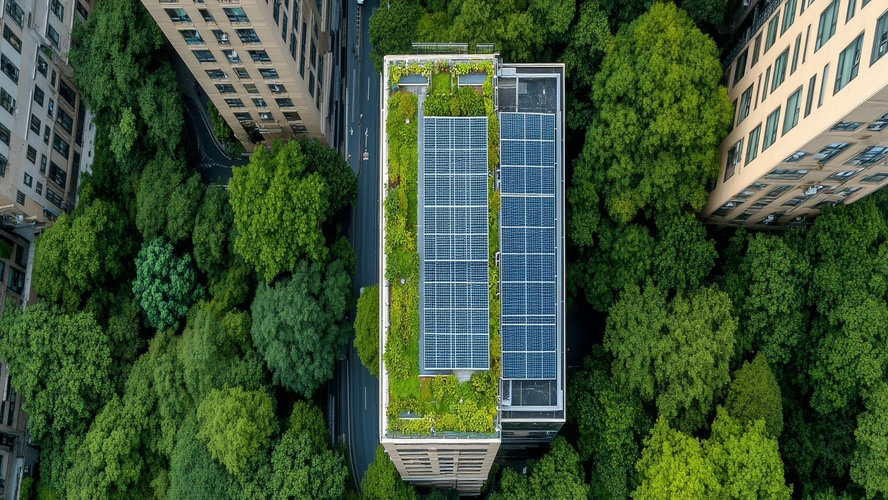
Actionable Example: Installing green roofs, endorsed by Green Roofs for Healthy Cities, reduces the urban heat island effect, increases roof membrane life, and absorbs precipitation, easing pressure on municipal stormwater systems.
Energy and Grid Independence
Integrating on-site renewable energy (solar, geothermal, wind microturbines) and battery storage enables buildings to remain operational during grid outages caused by storms and heat waves. The U.S. Department of Energy highlights the role of distributed energy systems in enhancing grid resilience.
Actionable Example: High-performance insulation and advanced glazing, aligned with ASHRAE building standards, lower cooling and heating loads, stabilizing indoor comfort even under extreme temperature swings.
Material Durability
Sustainable design prioritizes long-life, climate-resilient materials, such as fire-resistant cladding and moisture-resistant composites. The International WELL Building Institute emphasizes material health and resilience as core factors in long-term asset performance.
The Devaluation Risk: The Emerging Climate Risk Premium
As climate-related vulnerabilities become easier to quantify, financial markets are increasingly penalizing properties exposed to environmental risks.
Insurance Costs
Real estate located in coastal, wildfire-prone, or floodplain regions is experiencing rapidly escalating insurance premiums, a trend documented in industry analyses by Swiss Re. Rising premiums erode cash flow, reduce NOI, and impair asset values.
Stranded Assets
Buildings that fail to meet future energy performance standards or sit in high-risk climate zones may become stranded assets, meaning they are too costly to operate or upgrade. The TCFD (Task Force on Climate-Related Financial Disclosures) notes stranded asset risk as a key concern for global investors.
Lower Discount Rates and Better Financing
Sustainable, low-risk buildings frequently secure more favorable interest rates, as lenders adopt ESG metrics. Institutions guided by the PRI (Principles for Responsible Investment) increasingly allocate capital toward low-carbon, climate-resilient assets.
Meeting Evolving Market Demands and Regulatory Pressure
Market preferences and global policy are rapidly shifting toward sustainable buildings. Developers who invest early secure long-term competitiveness and compliance.
The Tenant and Occupant Premium
Today’s tenants, residential, commercial, and institutional, demand healthy, efficient, environmentally responsible buildings.
Employee Well-being
Corporate tenants increasingly prioritize buildings that support employee wellness. Certifications such as WELL and Fitwel emphasize daylighting, air quality, and biophilic design.
Features like green walls, enhanced ventilation, and natural light are now standard expectations for companies focused on talent retention.
Lower Operating Costs
Tenants benefit directly from reduced energy and water costs, one of the strongest drivers of tenant satisfaction and renewal. Research from ENERGY STAR proves that efficient buildings reduce utility expenses significantly, making them more attractive to occupants.
Green Leases
Landlords and tenants increasingly formalize sustainability through green leases, supported by the Institute for Market Transformation. These agreements standardize energy data sharing and codify operational efficiency commitments.
Regulatory Compliance and the Decarbonization Mandate
Governments worldwide are implementing aggressive building decarbonization rules, ensuring that inefficient properties face major compliance costs.
Building Performance Standards (BPS)
Cities like New York, Vancouver, and Washington, D.C. have adopted BPS that require buildings to meet minimum energy efficiency and emissions reductions by specific deadlines. The American Council for an Energy-Efficient Economy tracks this global shift.
Failing to comply often results in substantial fines.
Embodied Carbon Regulations
The global focus is expanding from operational emissions to embodied carbon, the emissions generated from construction and materials. The World Green Building Council has set ambitious targets for low-carbon construction.
This shift rewards developers who invest in:
- Low-carbon concrete
- Mass timber
- Reuse and adaptive retrofit strategies
Disclosure and Transparency
Many jurisdictions now require annual energy benchmarking and public disclosure. Tools like ENERGY STAR Portfolio Manager make building performance publicly visible, benefiting efficient properties and exposing underperformers.
The Future of Real Estate: Built on Sustainability

By prioritizing sustainability, developers and investors shift from short-term returns to a long-term, stewardship-based asset strategy. Buildings optimized for resilience, energy efficiency, and occupant health consistently outperform their peers, attracting premium tenants, favourable financing, and more reliable liquidity.
As noted across global climate and finance organizations, from UNEP to the PRI, the future viability of any real estate asset is tied directly to its environmental performance.
Those who invest in sustainability today are positioning their properties to:
- Withstand physical climate shocks
- Reduce operating expenses
- Capture rising tenant demand
- Avoid regulatory penalties
- Secure higher long-term valuations
The market is sending a clear message: sustainable buildings are simply better assets.

Energy Efficiency


Similar Posts